Key safes have become a practical solution for all sorts of households and properties. They make access simpler, reduce the need for physical handovers, and can be a real help when someone needs to get in quickly without you being there. That convenience, however, can give a false sense of security if the key safe itself is poorly made or badly fitted. A secure key safe can be a useful part of a wider access plan. A cheap one, or one installed in the wrong place, can create problems rather than solve them.
Why More People Are Using Key Safes
More households and property owners are turning to key safes because they solve everyday access issues in a simple way. For older residents, they can make it easier for carers or relatives to enter when support is needed. For families, they offer backup access without relying on hidden spare keys or last-minute dashes across town. For landlords, they can reduce delays between visits, maintenance appointments, and tenant access. Holiday-let owners also use them to avoid repeated key exchanges and make arrivals more straightforward.
The appeal is easy to understand. A key safe can save time, reduce hassle, and make access more flexible. It can also support independence for people who need help getting into the home without making the process feel intrusive or complicated. The important point is that convenience should never come at the expense of security.
The Big Difference – Secure vs Cheap Key Safes
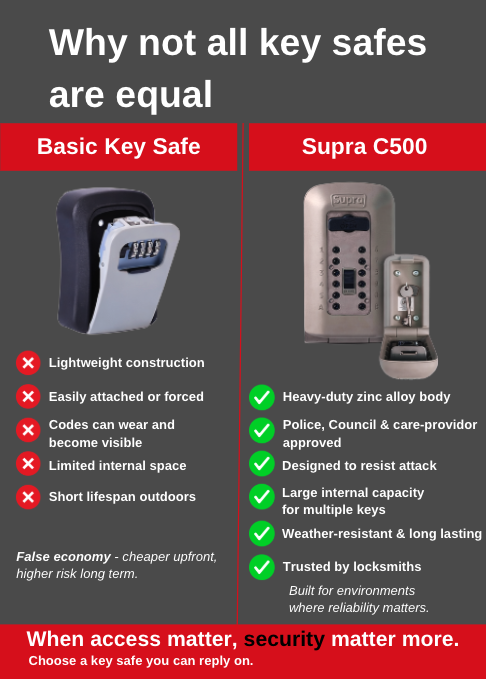
Not all key safes are built to the same standard. Some are designed with strong metal construction, solid locking mechanisms, and proper resistance to attack. Others are made with weaker materials, simpler mechanisms, and very little thought given to forced entry or long-term weather exposure.
Build quality makes a big difference. A well-made key safe should feel robust, close firmly, and resist twisting, prising, or tampering. The lock mechanism matters just as much. If the code wheels feel flimsy or the cover flexes too easily, that is usually a warning sign. Weather resistance also matters more than many people expect. A key safe fitted outside has to cope with rain, cold, changing temperatures, and daily use over time. If moisture gets into the mechanism or the casing begins to deteriorate, reliability can quickly drop.
This is also where the phrase ‘police approved’ often comes into the conversation. In practical terms, people are usually referring to products that have achieved recognised independent testing and accreditation, including products listed under Secured by Design’s Police Preferred Specification. Secured by Design describes itself as the official police security initiative, and states that accredited products must meet recognised security standards.
What “Police Approved” Actually Means
A police approved key safe is not simply a product with strong marketing or a reassuring label on the box. It means the product has been independently assessed against recognised standards and has demonstrated a level of resistance to attack that cheaper alternatives may never have been tested for.
That testing matters because a key safe is only useful if it can withstand real-world attempts to force it open or remove it. Secured by Design explains that its accreditation scheme is tied to recognised security standards, and products carrying its Police Preferred Specification have met those requirements. Some accredited key safes are also tested to LPS 1175 attack standards, which are specifically concerned with physical resistance.
For homeowners and landlords, certification matters because it gives you something objective to rely on, not just taking a seller’s word for it. You’re buying a product that has been tested in a meaningful way, which makes it far easier to separate genuinely secure options from low-cost models that only look convincing online.
Installation Matters More Than Most People Think
Even a high-security key safe can be undermined by poor installation and this is one of the most common mistakes people make. They spend time choosing the right model, then fix it to a surface that is too weak, too shallow, or too exposed, which immediately reduces the protection it offers.
The wall itself matters. Soft brick, crumbling mortar, lightweight surfaces, or poor fixing depth can all make removal far easier than it should be but let’s not forget about positioning, too. A key safe that is mounted in a very obvious place, fitted too low, or attached where it can be worked on easily without being seen may attract the wrong kind of attention. DIY fitting often goes wrong because people assume that if the unit feels secure on the surface, it must be secure overall. In reality, the fixing method, wall condition, depth of the anchors, and surrounding surface all need to be considered together.
This is why installation deserves just as much attention as product choice. A good key safe fitted badly can still fail. A properly installed one stands a far better chance of doing the job it was bought for.
Where Should a Key Safe Be Positioned?
The best position for a key safe balances discretion, access, and structural strength. It should be somewhere practical for authorised users to reach, but not immediately obvious to anyone approaching the property for the first time. A well-lit area is usually better than a hidden dark corner because it makes legitimate access easier and discourages covert tampering.
It is also important to avoid weak or unstable surfaces. Loose mortar, damaged brickwork, damp areas, or positions affected by constant water runoff can all create problems over time. Height matters as well. A key safe should be accessible, but not placed so low or so high that it becomes awkward to use or easy to spot. Good positioning is never random. It should be chosen with day-to-day use and long-term security in mind.
Who Should Consider a High-Security Key Safe?
For Elderly Residents
A high-security key safe can make access safer and more manageable for carers, relatives, and trusted visitors. It removes the need to leave keys under mats or in plant pots and can help someone remain independent while still making support easier to arrange.
For Landlords
Landlords often benefit from a secure access solution that reduces the need for repeated key handovers and helps avoid delays when contractors or agents need entry. It can also make emergency access far more straightforward when timing matters.
For Busy Families
Families often need a reliable fallback when plans change, keys are forgotten, or someone needs to get in quickly. A well-chosen key safe offers that convenience without relying on risky hiding places for spare keys.
When to Replace an Existing Key Safe
A key safe should not be treated as a fit-and-forget item. Over time, mechanical parts wear down, covers loosen, and the unit may become harder to operate reliably. If the code has been shared widely over the years, that alone may be reason enough to review it. Rust, physical damage, stiffness in the mechanism, or obvious wear around the casing are all signs that replacement may be the safer option.
Older non-certified models are also worth reconsidering. A key safe that was adequate years ago may no longer reflect current expectations around attack resistance or product testing. Replacing an outdated unit before it becomes a weak point is usually far easier than dealing with the consequences of keeping it too long.
Getting the Right Advice Before You Buy
A lot of key safes are sold online with very little useful information about certification, wall suitability, or installation requirements. That makes it easy to buy something that looks secure in a product photo but performs very differently once it is on the wall. The safest approach is often to speak to a local locksmith before you buy, especially if the key safe will be used regularly or forms part of a care, landlord, or property access arrangement.
Good advice at the start can save time, money, and unnecessary replacements later. It also gives you a clearer sense of what level of protection you actually need, rather than relying on vague product descriptions or generic ratings that do not tell the full story.
Professional Key Safe Installation from RLM Locksmiths
RLM Locksmiths offers practical, straightforward help with key safe selection and fitting. That includes advice on choosing a suitable model, checking the wall properly before installation, securing the unit with the correct fixings, and helping you set the code up safely once it is in place.
The aim is simple: to make sure the key safe you choose is not only convenient to use but properly installed and fit for the job. With the right product, fitted in the right place, a key safe can be a useful and secure part of everyday property access.